Industrial ergonomics
Warehouse lifting: keep the load close and the spine in a better place
Published
On a warehouse floor, most of the trouble we see is not a single dramatic lift. It is the same tote, the same reach into the bottom of a pallet, the same twist to a conveyor, repeated through a shift. People know they should "lift with the legs." They still end up bent, rotated, and away from the load because that is where the work was placed.
Training still matters. So does the layout. We would rather talk about both than pretend a toolbox talk will fix a picking slot that sits at mid-shin all morning.
The habits that actually help
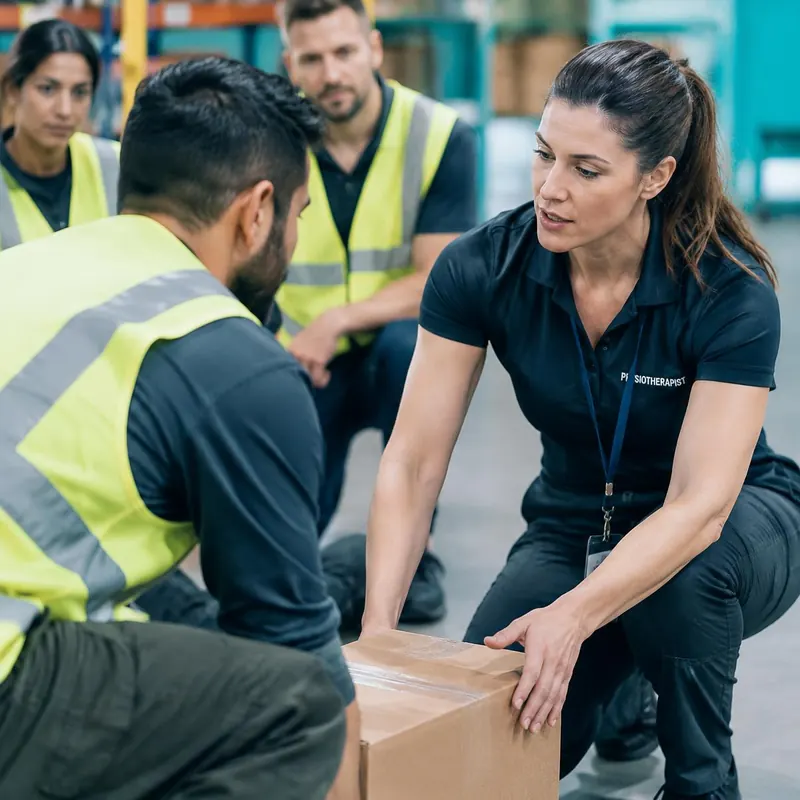
Keep the load close to the body. Get a secure grip before you move it. Keep a slight natural arch in the lower back, the same "power" position we talk about in an office chair, rather than rounding the back and hoping the legs will do all the work. Turn the feet to change direction, rather than twisting through the spine with the load in your hands. If you can, split a heavy or awkward load, or use a pallet truck, a lift table, or a second person.
These are not new ideas. They fail in practice when the pallet is deep, the aisle is tight, or the next station is behind the shoulder. Then people do what the job requires, and the back and shoulders take it.
Work height is a design problem
Lifting from the floor, or from above the shoulders, for cycle after cycle, is a different issue from an occasional box on the ground. If a product always lives on the bottom layer, that is a slotting question. If outbound totes are consistently overweight, that is a packaging or order-size question. An industrial visit looks at those patterns, not only at the worker's technique.
Standing on one side of a pallet and reaching across it is another classic. Walk around. It feels slower until you add up the reaches you did not do.
Team lifts need a plan, not just an extra pair of hands. If one person is walking backward and the other cannot see the landing, the load twists anyway. Agree who leads, where it will land, and whether a mechanical aid would have been the better first choice. We would rather have that conversation at the start of a shift than after someone has already tried to "just get it."
What training can and cannot do
In ergonomic training for warehouse and plant crews, we practise the lift with the loads people actually handle, at the stations they use. A classroom with a single empty box is weaker. People should leave having felt the difference between a load against the body and a load at arm's length. They should also leave knowing they can say when a task is a poor fit, rather than treating every awkward lift as a personal failing.
If discomfort or claims are clustering on one line, start with a workplace ergonomic assessment. We will watch the work, look at postures, forces, and repetition, and put the findings in a report you can take to operations and to facilities. Sometimes the answer is a height-adjustable stand, a different pallet pattern, or a small change in how orders are built. Sometimes it is coaching. Often it is both.
Ontario employers already have a duty to take reasonable precautions for MSD hazards, including manual handling. We are not here to recite the Regulation at you. We are here to help you see where the work is loading people, and what you can change. If you want that look at a GTA warehouse or plant, contact us.